

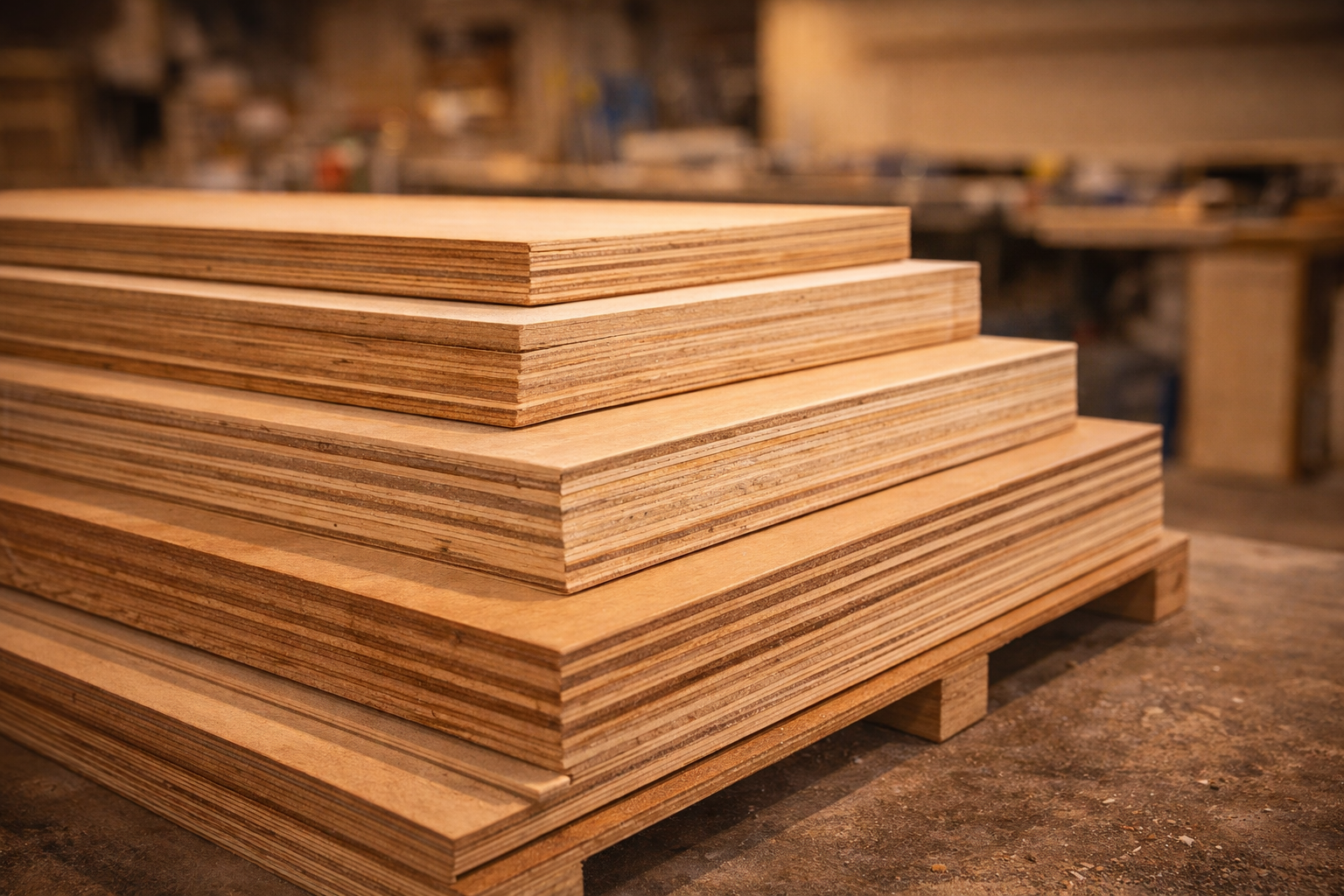
Why Thickness Has Such a Big Impact
Plywood thickness directly affects:
- Load-bearing capacity
- Span performance
- Fixing strength
- Resistance to impact and deflection
A panel that performs well in one application may fail prematurely if used at insufficient thickness elsewhere.
These considerations sit alongside broader guidance in How to Choose the Right Plywood for Your Project, where application-specific selection is critical.
Typical Thickness Ranges and Where They Work
Thinner plywood panels are commonly used for interior wall linings, ceilings and decorative joinery where loads are minimal and fixing demands are low.
Structural and subfloor applications require greater thickness to manage load, span and long-term movement. In these cases, thickness selection is just as important as grade selection.
Bord’s plywood range supports both structural and decorative applications across a wide range of thicknesses.
Structural vs Non-Structural Performance
Structural plywood is manufactured to meet specific load requirements under Australian standards. Thickness selection in these applications should always align with engineering advice and manufacturer recommendations.
Non-structural plywood allows more flexibility, but designers still need to consider fixing methods, expected wear and environmental exposure. These distinctions are explored further in Commercial-Grade Plywood Explained: Strength, Stability and Smart Australian Applications.
Specialised Environments
Marine plywood often requires increased thickness where constant moisture exposure and mechanical stress are present. Flooring and high-traffic applications may also benefit from thicker panels to reduce movement over time.
Understanding how thickness interacts with grade supports better outcomes, particularly when paired with insights from Australian Plywood Grades Explained: A, B, C, D, and O.
Designing for Longevity
Correct thickness selection is one of the simplest ways to improve plywood performance. Aligning thickness, grade and application early helps avoid deflection, fixing issues and unnecessary callbacks.


Explore Bord Products
Our Melbourne facility produces hundreds of veneer and laminate panels daily, giving us total control over timeframes and quality.

Visit Our Showroom
Get expert advice on material selection for your project and see our entire range of veneers and laminates in person.

Specify Sustainable
We support sustainable forest management in Australia and across the globe. Look out for certified products on our website or speak to us.