

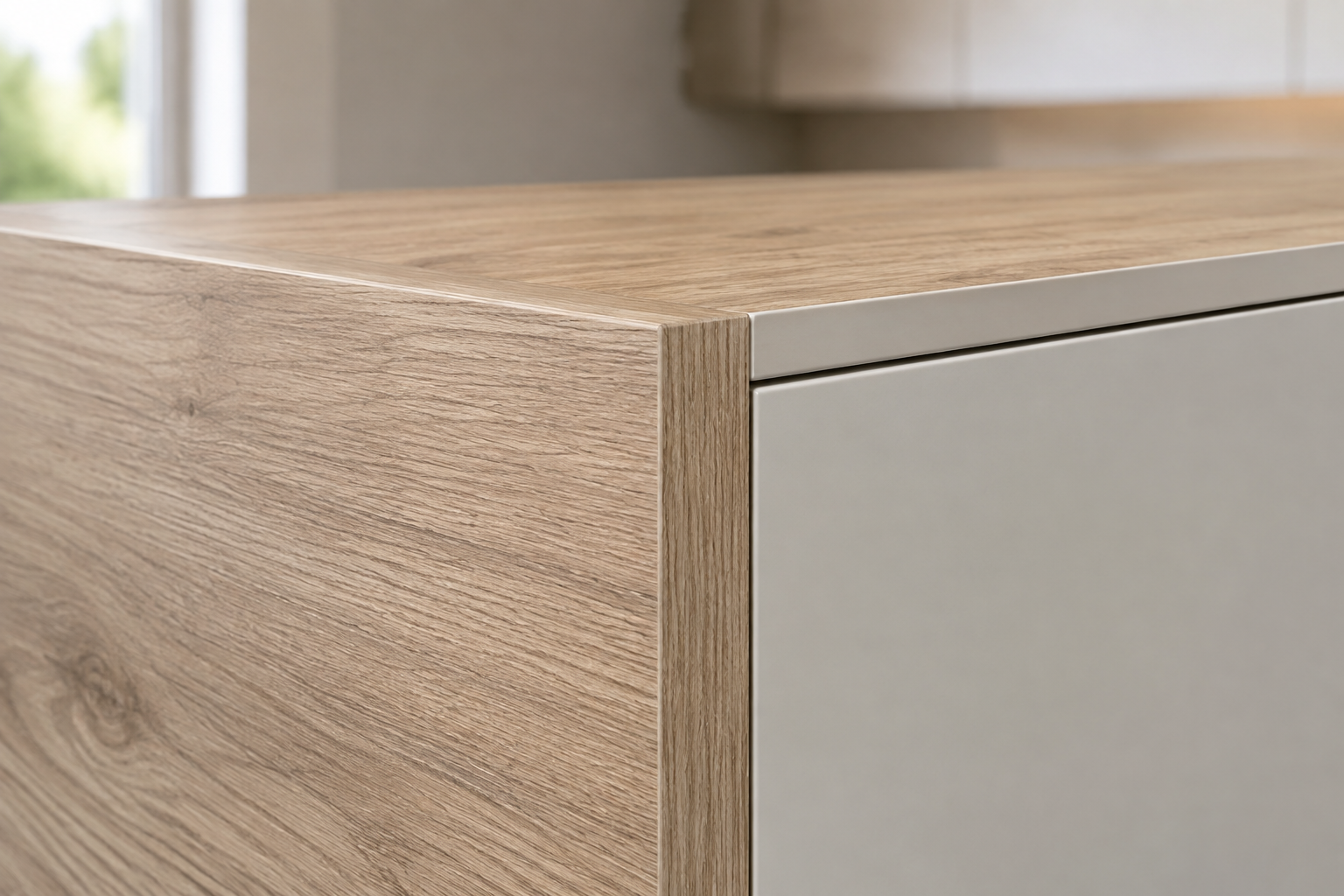
Why Edge Banding Matters
Panel edges expose the core material, which is usually more vulnerable than the face. Left unfinished, edges can chip, absorb moisture and detract from the overall appearance of a piece.
Edge banding addresses several issues at once:
- Protecting the core from moisture and impact
- Preventing chipping along machined edges
- Delivering a clean, finished appearance
- Improving durability in high-use joinery
Common Types of Edge Banding
Different edge banding materials suit different applications, budgets and finishes. The most common options include:
- PVC and ABS edging for durability and impact resistance
- Melamine edging for matching laminate and melamine faces
- Timber veneer edge tape for a natural, continuous look
- Pre-glued iron-on tapes for smaller or manual applications
Machine-applied edging using EVA or PUR adhesives generally provides the strongest, most consistent bond for commercial volumes.
Matching Edge Banding to the Panel
The best results come from treating the edge and the face as a single decision. A laminate panel usually pairs with a matching melamine or PVC edge, while a veneered panel is best finished with a matching timber veneer tape.
For guidance on selecting the right surface in the first place, see Types of Laminates Explained for Australian Commercial Projects. Bord's laminate and melamine range and timber veneer range can be matched with complementary edging.
Avoiding Edge Failures
Most edge problems come down to moisture ingress or poor adhesion. In wet or humid areas, using a moisture-resistant substrate under the edge banding makes a significant difference to long-term performance.
This is closely tied to substrate choice, as explored in HMR MDF vs Standard MDF: What Specifiers Need to Know.
Getting a Seamless Finish
For veneered joinery, grain and colour matching across the edge is what separates a refined finish from an average one. Reconstituted and engineered veneers offer more consistent colour when uniformity across large runs is important.
Bord's MDF range provides a stable, uniform substrate that supports clean edge banding and a smooth overall result.
Specifying with the Whole Panel in Mind
Edge banding should never be an afterthought. When the edge, face and substrate are specified together, panels last longer, look better and hold up to everyday use across both residential and commercial projects.


Explore Bord Products
Our Melbourne facility produces hundreds of veneer and laminate panels daily, giving us total control over timeframes and quality.

Visit Our Showroom
Get expert advice on material selection for your project and see our entire range of veneers and laminates in person.

Specify Sustainable
We support sustainable forest management in Australia and across the globe. Look out for certified products on our website or speak to us.