

What this article explores
This blog breaks down the practical differences between teak veneer and solid teak in commercial settings. We’ll look at performance, stability, cost considerations and design flexibility, all from an Australia-wide perspective. If you’re weighing up which option makes more sense for your next commercial fit-out, this guide will help clarify the decision.
The fundamental difference between veneer and solid timber
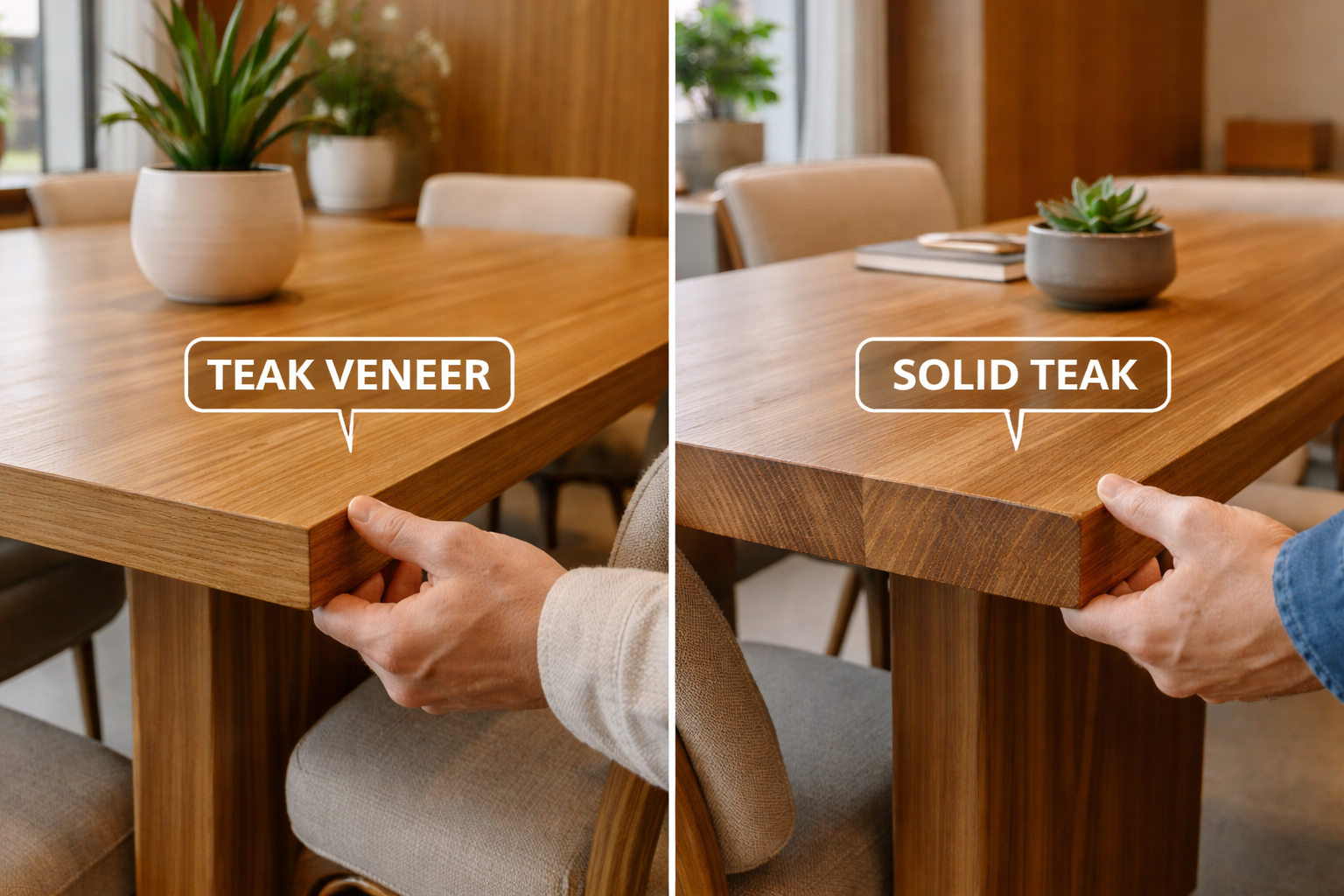
At surface level, teak veneer and solid teak can appear almost identical once installed and finished. The real difference lies in construction.
Solid teak is milled from full timber boards. Teak veneer is a thin slice of teak applied to a stable substrate such as MDF or plywood. In commercial interiors, that structural distinction plays a major role in how the material performs over time.
Australian buildings experience a wide range of internal conditions. Air-conditioning, heating, humidity control and occupancy levels can all cause timber movement. Solid teak, while durable, naturally expands and contracts. Over large wall areas or long joinery runs, this movement can result in visible joins or minor surface irregularities.
Teak veneer significantly reduces these risks. The stable substrate beneath the veneer limits movement, making it a more predictable option for large commercial installations.
Performance in real-world commercial environments
Durability is often associated with solid timber, but durability alone doesn’t always translate to better performance in commercial interiors. In offices, hotels and retail environments, consistency and stability are often more valuable than raw material thickness.
Teak veneer performs particularly well across large surfaces where visual uniformity is critical. Wall panelling, reception desks, boardroom joinery and integrated furniture all benefit from the controlled grain and colour matching veneer allows.
Solid teak can still be appropriate in certain applications, particularly for standalone furniture or feature elements where movement can be accommodated. However, for extensive wall linings and joinery, veneer often delivers a cleaner, more reliable outcome over time.
For projects requiring premium finishes with predictable performance, ranges such as teak veneer are commonly specified across Australian commercial interiors.
Cost efficiency and sustainability considerations
Commercial projects operate within budgets, even at the high end. Solid teak typically comes with higher material costs, increased waste allowances and more complex installation detailing to manage movement.
Teak veneer uses significantly less hardwood, making it a more efficient use of timber resources. This not only improves cost control but also aligns with sustainability objectives increasingly built into Australian commercial projects.
From an environmental standpoint, veneer allows designers to achieve the look of teak while minimising the volume of slow-growing hardwood required. For many clients, this balance between aesthetics and responsible sourcing is a key factor in material selection.
Design flexibility across large projects
One of the biggest advantages of teak veneer is how easily it integrates with other commercial panel products. Modern interiors often require different substrates depending on performance needs—acoustic backing, fire-rated cores or moisture-resistant panels, for example.
Working with a supplier like Bord Products allows designers and builders to coordinate veneer finishes across multiple panel types, maintaining a consistent appearance while meeting varied technical requirements.
And when projects call for more than one timber tone, selecting finishes from a broader timber veneer collection helps create cohesive interiors without limiting design flexibility.
FAQs about teak veneer vs solid teak
Does solid teak last longer than teak veneer?
Not necessarily in commercial interiors. Veneer often performs better over large areas because it’s more stable and less prone to movement.
Can clients tell the difference once installed?
In most cases, no. When specified and finished correctly, teak veneer delivers the same visual impact as solid teak.
Is teak veneer suitable for premium commercial projects?
Yes. Veneer is widely used in high-end offices, hotels and retail spaces for its consistency and refined appearance.
When is solid teak the better option?
Solid teak can be ideal for smaller, freestanding furniture pieces or feature elements where timber movement is less of a concern.
Making the right choice for your project
Across Australia, teak veneer is often the more practical choice for commercial interiors. It offers the look and feel of teak with greater stability, efficiency and control—qualities that matter when projects need to perform reliably long after handover.
Solid teak still has its place, but for most large-scale commercial applications, teak veneer delivers a smarter balance between beauty, performance and sustainability.


Explore Bord Products
Our Melbourne facility produces hundreds of veneer and laminate panels daily, giving us total control over timeframes and quality.

Visit Our Showroom
Get expert advice on material selection for your project and see our entire range of veneers and laminates in person.

Specify Sustainable
We support sustainable forest management in Australia and across the globe. Look out for certified products on our website or speak to us.