

What this article covers
This blog explores why teak veneer is so widely specified across Australian commercial projects. We’ll look at its performance benefits, where it’s commonly used, and why veneer often makes more sense than solid timber in large-scale interiors. If you’re specifying materials for a commercial fit-out anywhere in Australia, this guide will help you understand where teak veneer fits into the decision-making process.
What makes teak veneer so effective in commercial environments
Teak is known globally for its durability and distinctive grain, but using it as a veneer unlocks additional advantages for commercial applications. Teak veneer offers the same visual warmth as solid teak, while significantly improving dimensional stability—an important factor in large interiors.
Australian commercial buildings often experience fluctuating internal conditions due to air-conditioning, heating and varying occupancy levels. Veneered panels are far less prone to expansion and contraction, reducing the risk of visible joins, warping or cracking over time.
Consistency is another key benefit. Commercial projects frequently require extensive wall linings, joinery and feature panels to match across multiple spaces. Veneer allows for careful grain and colour selection, ensuring a cohesive finish that’s difficult to achieve with solid timber at scale.
For specifiers seeking premium, commercial-grade options, starting with a dedicated range such as teak veneer provides both aesthetic quality and predictable performance.
Where teak veneer is commonly used across Australia
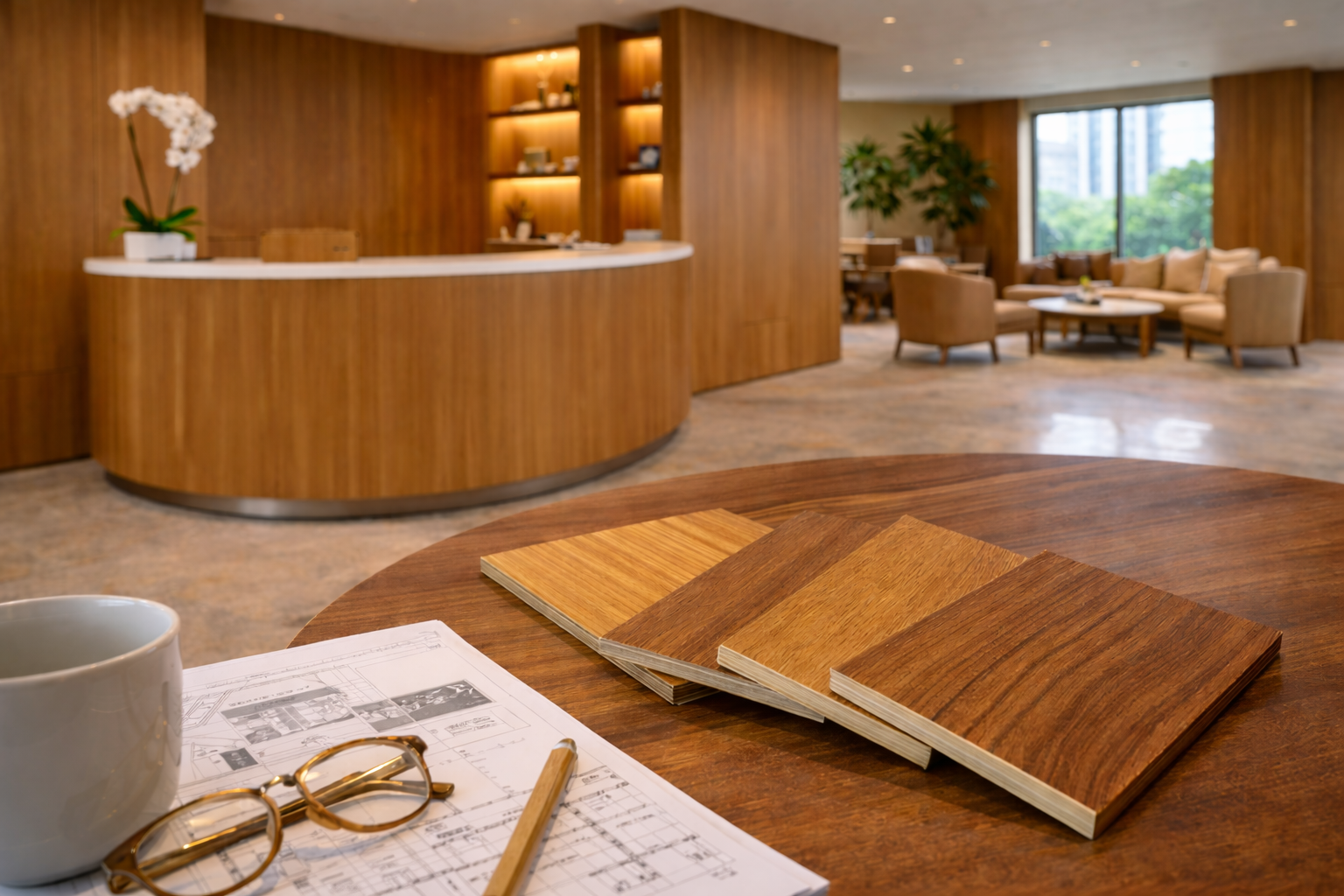
Teak veneer is widely used across office environments for reception desks, boardroom joinery and wall panelling, where it helps balance professionalism with warmth. In hospitality settings, it’s often specified for bars, wall features and integrated seating to create inviting spaces without overwhelming the design.
Retail environments benefit from teak veneer’s durability and refined appearance, particularly for counters, display walls and shelving. In education, healthcare and public buildings, it’s frequently chosen for internal linings and joinery due to its stability and low maintenance requirements.
Sustainability is also a growing consideration nationwide. Veneer uses significantly less hardwood than solid timber, supporting more efficient use of natural resources while still delivering the look designers and clients expect.
Integrating teak veneer into a broader material strategy
Modern commercial interiors rarely rely on a single material. Teak veneer often forms part of a broader palette of engineered timber and panel products, each selected to suit specific performance requirements.
Working with an established supplier such as Bord Products allows designers and builders to coordinate finishes across different substrates, ensuring visual consistency while meeting structural, acoustic or fire-rating needs.
For projects that require multiple timber tones or grain styles, selecting from a wider timber veneer collection makes it easier to create cohesive interiors across large or multi-stage developments.
Frequently asked questions about teak veneer
Is teak veneer suitable for high-traffic commercial spaces?
Yes. When properly finished and installed, teak veneer performs well in offices, hospitality venues and retail environments across Australia.
Does teak veneer require special care?
No. Standard cleaning routines and appropriate protective finishes are generally sufficient for long-term performance.
Can teak veneer be used on custom joinery and wall panels?
Absolutely. Veneer is commonly specified for custom joinery, wall linings and architectural features.
Is teak veneer more economical than solid teak?
In most commercial applications, yes. Veneer offers the appearance of teak with greater material efficiency and reduced installation risk.
A dependable choice for Australian commercial interiors
Teak veneer continues to be specified across Australian commercial interiors because it balances aesthetics with real-world performance. It offers warmth, consistency and longevity, while accommodating the practical demands of large-scale projects.
For designers and specifiers seeking a premium timber finish that performs reliably across varied environments, teak veneer remains a smart and versatile choice.


Explore Bord Products
Our Melbourne facility produces hundreds of veneer and laminate panels daily, giving us total control over timeframes and quality.

Visit Our Showroom
Get expert advice on material selection for your project and see our entire range of veneers and laminates in person.

Specify Sustainable
We support sustainable forest management in Australia and across the globe. Look out for certified products on our website or speak to us.