

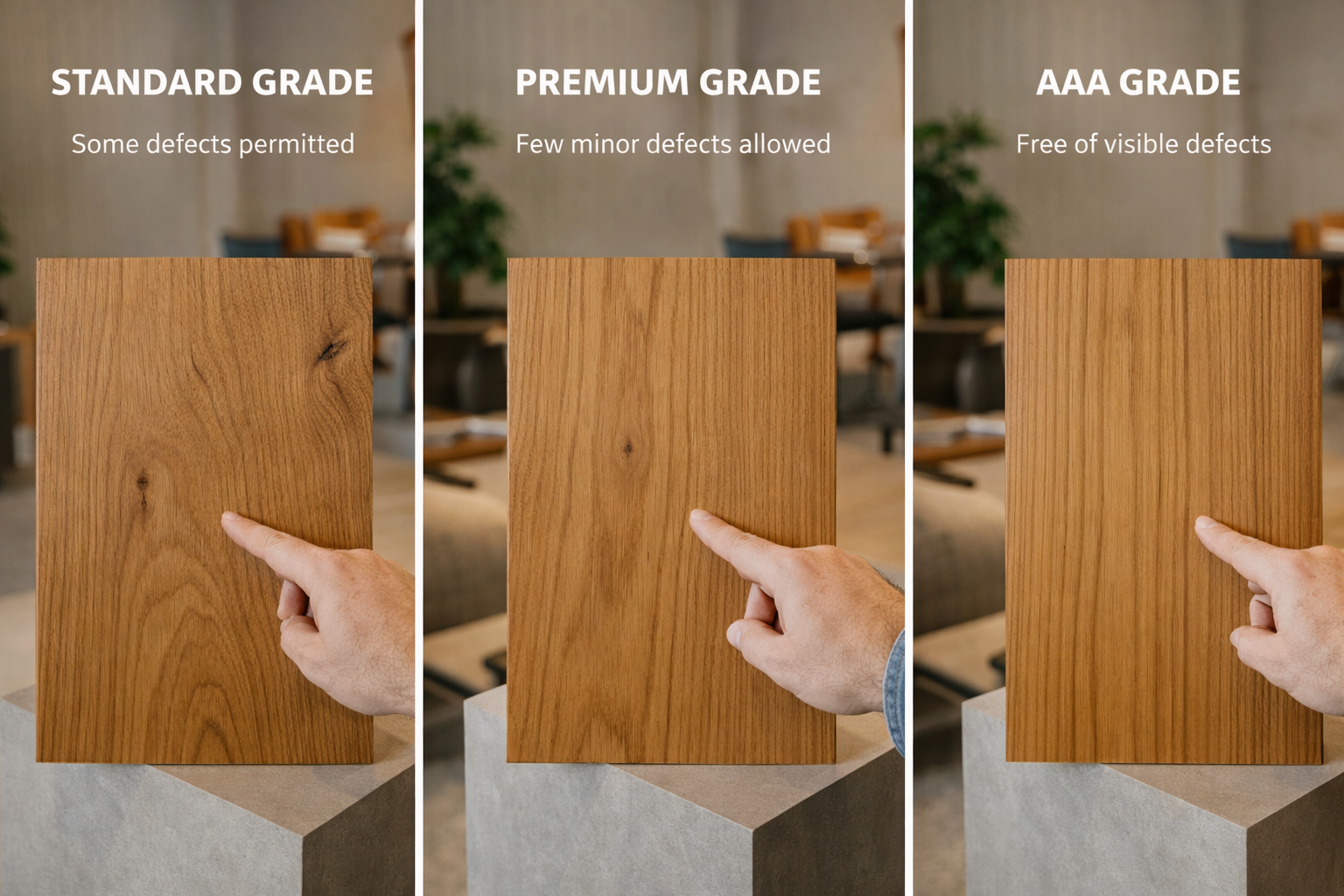
What timber veneer grading actually refers to
Unlike solid timber, veneer grading isn’t about structural strength. Instead, it focuses on appearance. Veneer grades assess the visual characteristics of the timber slice, including grain pattern, colour consistency and natural features.
Common grading factors include:
- Colour variation across sheets
- Grain consistency and direction
- Presence of natural characteristics such as knots, mineral streaks or sapwood
- Overall uniformity when multiple sheets are laid together
In commercial interiors, where veneer is often used across large surfaces, these visual factors are critical. A higher or more consistent grade makes it easier to achieve a cohesive finish across wall linings, joinery and architectural elements.
Why grading matters in commercial environments
Australian commercial projects often require veneer to be installed across multiple panels, levels or zones. In these situations, inconsistent grading can lead to noticeable colour shifts or irregular grain patterns, even if the same species is used.
Higher-grade veneers typically offer greater visual consistency, which is particularly important in reception areas, boardrooms, hospitality venues and retail spaces where the veneer finish is a key design feature.
That doesn’t mean lower or more character-filled grades don’t have a place. In some hospitality or creative environments, natural variation can add warmth and authenticity. The key is choosing the right grade intentionally, rather than leaving the outcome to chance.
Matching veneer grade to application
One of the most important decisions for specifiers is aligning veneer grade with its application. High-visibility areas usually benefit from more uniform grading, while secondary spaces can comfortably accommodate more variation.
For example, feature walls or front-of-house joinery often require a refined, consistent appearance. Back-of-house areas, cabinetry interiors or less prominent walls may allow for more character in the veneer without compromising the overall design intent.
This is where working with an experienced supplier becomes valuable. Access to well-curated veneer ranges and guidance on grading helps ensure the finished space looks as intended once installed.
Suppliers such as Bord Products offer commercial-grade veneer options designed to deliver predictable results across large-scale projects.
Species selection and grading go hand in hand
Different timber species naturally display different levels of variation. Some species are prized for uniform grain, while others are known for expressive patterns and tonal shifts.
Teak, for example, sits comfortably in commercial interiors because it balances character with consistency. Selecting a well-managed veneer range such as teak veneer allows specifiers to control the final look while still showcasing the natural beauty of the timber.
For projects that involve multiple timber finishes, sourcing from a broader timber veneer collection makes it easier to coordinate grades and tones across different species.
FAQs about timber veneer grading
Are higher veneer grades always better?
Not necessarily. Higher grades offer more consistency, but lower or character grades can be ideal when variation is part of the design intent.
Can veneer grading affect cost?
Yes. Veneers with tighter colour and grain consistency typically command a higher price due to increased selection and processing.
Is grading standardised across suppliers?
Grading criteria can vary, which is why it’s important to review samples and understand how a supplier defines each grade.
Should veneer grade be specified in documentation?
For commercial projects, yes. Clearly specifying veneer grade helps avoid inconsistencies during procurement and installation.
Making confident veneer selections
Understanding timber veneer grades gives specifiers greater control over the final outcome of a commercial interior. It ensures the material selected aligns with the design intent, performs consistently across large surfaces, and meets client expectations.
For Australian commercial projects where finish quality matters, taking the time to consider veneer grading is one of the simplest ways to achieve a more polished, predictable result.


Explore Bord Products
Our Melbourne facility produces hundreds of veneer and laminate panels daily, giving us total control over timeframes and quality.

Visit Our Showroom
Get expert advice on material selection for your project and see our entire range of veneers and laminates in person.

Specify Sustainable
We support sustainable forest management in Australia and across the globe. Look out for certified products on our website or speak to us.