

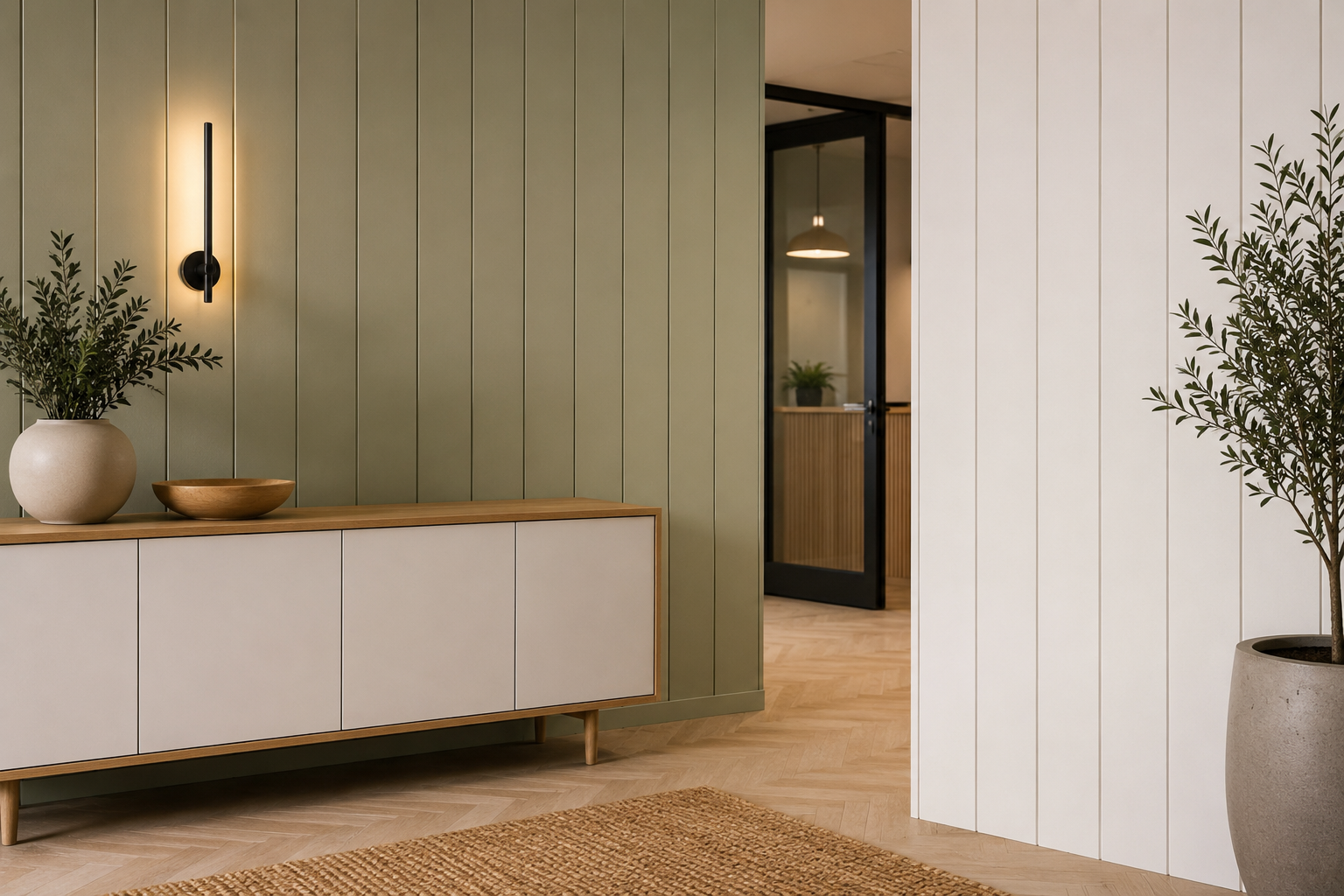
Why Substrate Choice Matters
VJ panelling introduces repetition, shadow lines and depth across large surfaces. Any inconsistency in the substrate becomes more visible once profiles are machined or installed.
Performance is influenced by:
- Stability over time
- Resistance to moisture
- Machining quality
- Edge durability
These factors should guide the choice between MDF and plywood rather than cost alone.
Where MDF Performs Best
MDF is widely used for VJ panelling because of its smooth, consistent structure. It machines cleanly, making it ideal for:
- Painted VJ wall panels
- Detailed or narrow profiles
- Interior applications with controlled conditions
Bord’s MDF range is commonly specified where precision and finish quality are the priority.
This aligns with design approaches explored in VJ Panelling in Contemporary Australian Interiors: Beyond the Hamptons Look.
Where Plywood Is the Better Option
Plywood offers greater strength and durability, making it more suitable for:
- High-impact commercial environments
- Areas where edges are exposed
- Installations with fluctuating humidity
It also introduces a natural grain that can be incorporated into the design when a more material-driven finish is required.
For these applications, Bord’s plywood panels provide improved resilience compared to MDF.
Moisture and Environmental Considerations
In coastal or high-humidity environments, MDF can be more susceptible to swelling if not properly specified. Moisture-resistant MDF improves performance, but plywood often remains the more stable choice in these conditions.
This reflects broader considerations outlined in Designing for Durability on the Australian East Coast: Choosing Panels for Heat, Humidity and Salt Air.
Designing with Intent
There is no single “best” option for VJ panelling. MDF and plywood each serve different purposes. Selecting the right substrate comes down to understanding the environment, finish and expected wear.


Explore Bord Products
Our Melbourne facility produces hundreds of veneer and laminate panels daily, giving us total control over timeframes and quality.

Visit Our Showroom
Get expert advice on material selection for your project and see our entire range of veneers and laminates in person.

Specify Sustainable
We support sustainable forest management in Australia and across the globe. Look out for certified products on our website or speak to us.