

Why curves matter in commercial design
Curves aren’t just an aesthetic choice. In commercial environments, they can help improve flow, reduce visual rigidity and make large spaces feel more inviting. Offices use curved elements to soften open-plan layouts, hospitality venues use them to guide customers through spaces, and retail environments rely on curves to create focal points that feel dynamic and approachable.
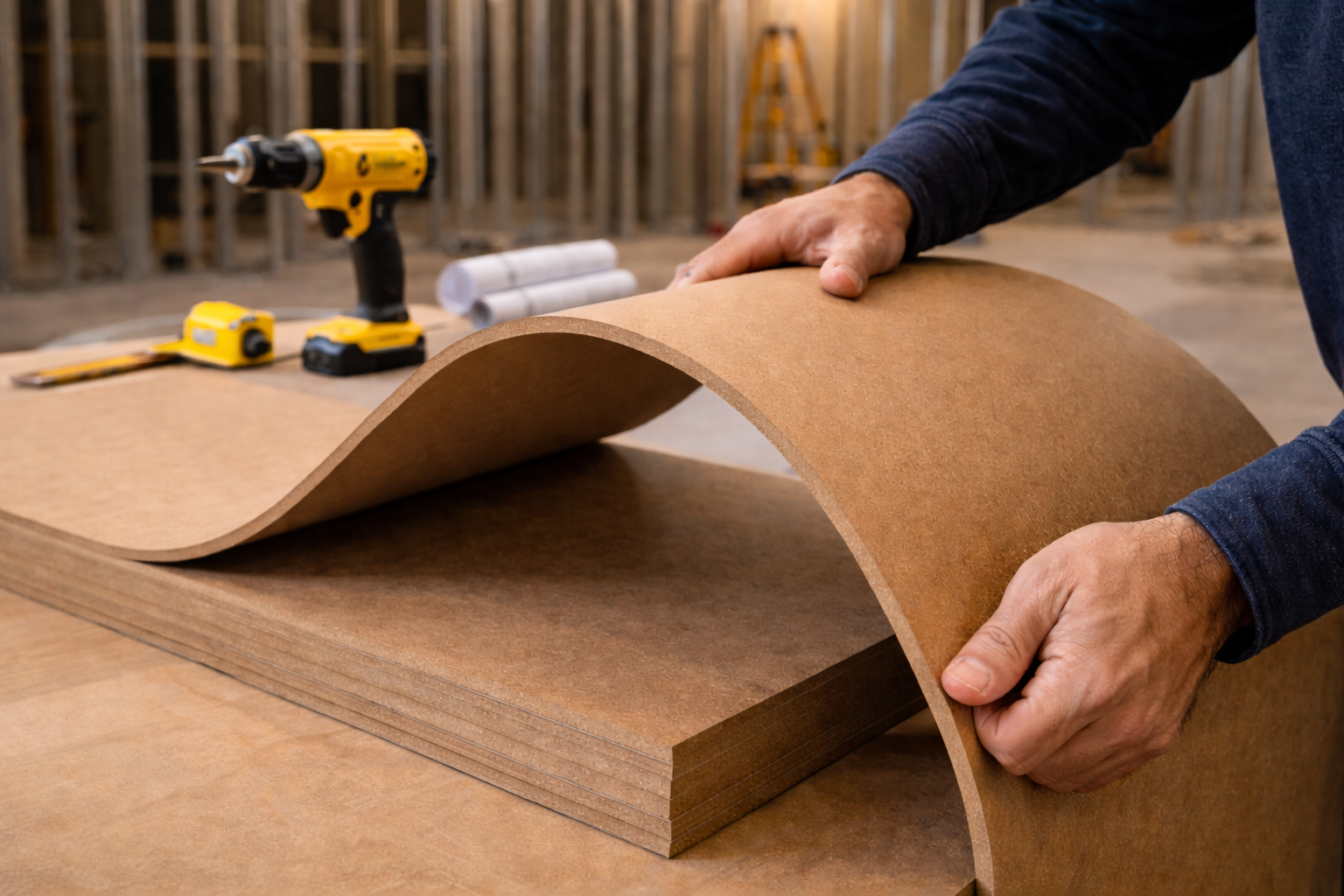
The challenge has always been execution. Traditional materials can be difficult, time-consuming or costly to form into smooth curves. Bendable MDF simplifies that process, making curved design more accessible and consistent.
What makes bendable MDF different
Plywood is often specified where strength and rigidity are priorities. Its layered construction makes it well suited to load-bearing applications such as cabinetry carcasses, shelving, counters and joinery frameworks.
In AustraBendable MDF is manufactured with a specialised internal structure that allows it to flex in one direction without cracking or losing surface integrity. This flexibility means panels can be wrapped around frames or formers to create smooth, controlled curves.
Once installed, bendable MDF can be finished just like standard MDF. It accepts paint, laminates and veneer finishes, allowing curved elements to integrate seamlessly with surrounding joinery and wall linings.
For designers and builders looking to introduce curvature into commercial spaces, products like bendable MDF provide a reliable starting point.internal conditions. It handles fixings well, resists sagging and maintains its shape over long spans, making it a dependable substrate behind finished surfaces.
When paired with decorative finishes, plywood provides a strong base that helps veneers and laminates perform consistently. This is one reason it’s commonly used behind wall linings and feature panels in high-traffic commercial areas.
Where bendable MDF is commonly used
Across Australian commercial projects, bendable MDF is used in a wide range of applications. Reception desks and counters are a common example, where curved fronts create a strong first impression. Wall features, columns and bulkheads also benefit from its flexibility, especially in large open spaces that need visual interest.
In retail and hospitality settings, bendable MDF is often used for display units, bars and seating surrounds, where curves help guide movement and soften transitions between zones. In offices, it’s frequently specified for feature walls and acoustic treatments that move away from rigid geometry.
Pairing bendable MDF with premium finishes
One of the key advantages of bendable MDF is how easily it integrates with high-quality finishes. Once formed, the panel can be finished to match surrounding materials, ensuring curved elements don’t feel like an afterthought.
Timber veneers are a popular choice for this reason. Applying finishes from a curated timber veneer collection allows curved walls or joinery to maintain the same warmth and texture as flat surfaces elsewhere in the fit-out.
For more refined commercial interiors, veneers such as teak are often selected for curved applications because their balanced grain helps minimise visual distortion when wrapped around a radius.
Practical benefits for builders and installers
From a construction perspective, bendable MDF offers predictability. It’s designed to bend consistently, reducing the trial-and-error often associated with forming curved elements using standard sheets.
This predictability can translate to faster installation times and cleaner finishes on site—important considerations on commercial projects where timelines and coordination are tight.
Sourcing materials through established suppliers like Bord Products also helps ensure compatibility between substrates and finishes, reducing risk during fabrication and installation.
FAQs about bendable MDF
Is bendable MDF strong enough for commercial use?
Yes. When installed over appropriate framing or substrates, it performs well in commercial interiors.
Can bendable MDF be painted or veneered?
Absolutely. It accepts paint, laminates and veneer finishes like standard MDF.
Is it suitable for tight curves?
Bendable MDF is designed for controlled bending. The achievable radius depends on product specifications and installation method.
Where should bendable MDF not be used?
It’s best suited to internal applications and should be specified appropriately where moisture exposure is a concern.
Curves made practical
Bendable MDF has opened the door for more expressive, fluid commercial interiors across Australia. It allows designers to introduce curves without excessive cost or complexity, while still delivering clean, professional finishes.
For projects looking to move beyond straight lines and sharp angles, bendable MDF offers a practical and versatile solution that fits comfortably within modern commercial design.


Explore Bord Products
Our Melbourne facility produces hundreds of veneer and laminate panels daily, giving us total control over timeframes and quality.

Visit Our Showroom
Get expert advice on material selection for your project and see our entire range of veneers and laminates in person.

Specify Sustainable
We support sustainable forest management in Australia and across the globe. Look out for certified products on our website or speak to us.