


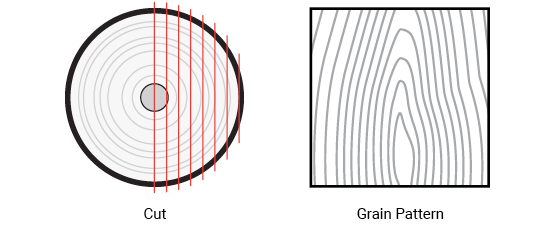
Crown Cut Veneer
For crown cut veneers, the log is cut in half, and the halved log is then sliced straight across. The cut runs parallel to a line through the centre of the log, and at a tangent to the growth rings. Crown cut veneers tend to have a strong grain pattern in their centre and a more linear effect at the edges.
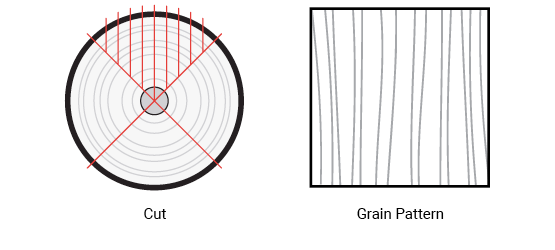
Quarter Cut Veneer
To create a quarter cut veneer, the log is first cut into quarters, creating four flitches. Each quarter flitch is then straight sliced, at roughly right angles to the growth rings. This then produces a veneer with a uniform lined vertical grain.
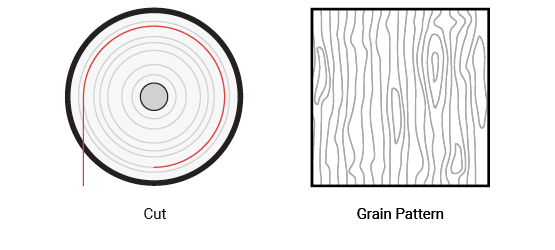
Rotary Cut Veneer
This veneer is created by slicing the log around its circumference, following the annual growth rings. This creates a bold, variegated grain, and enables very wide leaves to be produced. Rotary cut veneers are most often used in plywood production.

Rift Cut Veneer
Rift cutting is used mainly for Oak species, which have lines radiating out from the centre of the log. The log is quarter cut, with each quarter being sliced slightly across the outward radiating lines of the tree. This accentuates the vertical grain.
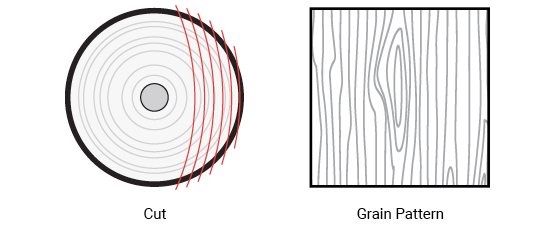
Half Round Cut Veneer
For half round cut veneer, the log is mounted off-centre in a lathe. Slices are then taken slightly across the growth rings. This produces veneer leaves with some of the visual characteristics of both crown cut and rotary veneers.
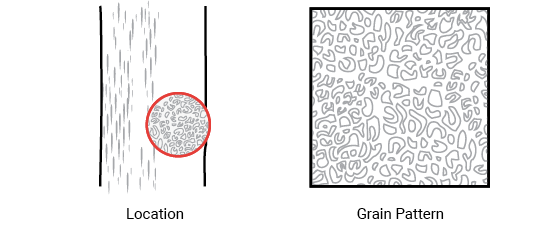
Burl Veneer
A burl is a tree growth in which the grain has grown in a deformed manner. It’s commonly found in the form of a round outgrowth on a tree trunk or branch, often filled with small knots from dormant buds. Burl veneers are valued for their highly intricate and unique patterns.
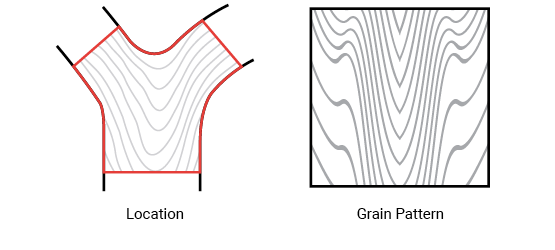
Curl Veneer
Curl veneer is created by cutting at the junction of tree trunk and branches. The unique patterning is the result of the wood that’s been confined and twisted between the two limbs as they increase in size.
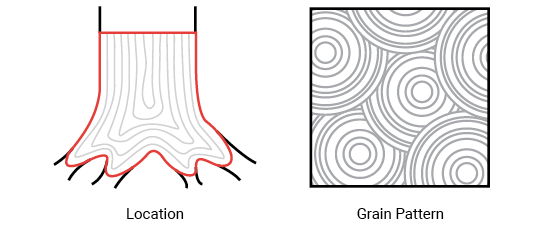
Butt Veneer
Butt veneer is created by slicing the logs across the annual rings occurring at the ends as opposed to standard quarter cut or crown cut. These small veneers, when laid out onto panels, give an illusion of natural round logs stacked onto each other.


Explore Bord Products
Our Melbourne facility produces hundreds of veneer and laminate panels daily, giving us total control over timeframes and quality.

Visit Our Showroom
Get expert advice on material selection for your project and see our entire range of veneers and laminates in person.

Specify Sustainable
We support sustainable forest management in Australia and across the globe. Look out for certified products on our website or speak to us.